
Deck Storage Bench Guide for Guelph Homeowners

If you've got a Guelph backyard that always seems to be one cushion pile, one toy bin, and one garden hose away from looking untidy, a deck storage bench starts to look less like a décor choice and more like a practical fix. The right unit gives you a place to sit, a place to hide the clutter, and a way to keep the deck feeling open instead of crowded.
The mistake I see most often is people treating every bench-shaped outdoor box like the same thing. It isn't. A seat-first storage bench changes how the deck works day to day, while a storage-first deck box changes how much gear you can tuck away. That difference matters more once you start thinking about framing, moisture, and how long you want the setup to last in Ontario weather.
Table of Contents
What a Deck Storage Bench Actually Is - The easiest way to classify your need
Built-In Versus Freestanding Storage Benches - Code and resale are part of the choice
Material Choices for Guelph Decks - What each material is really good at
Sizing, Load Capacity, and Framing Considerations - Read the spec sheet like a builder - Where the bench should sit
Moisture Management in Ontario's Freeze-Thaw Climate - The real failure mode is trapped dampness - What to do with a bench cavity
DIY Installation Versus Hiring a Deck Builder - What DIY does well - What a professional adds
Realistic Cost Ranges for Guelph Homeowners - What drives the price
Permits, Code, and Your Next Steps in Guelph - Quick answers before you call a contractor
What a Deck Storage Bench Actually Is
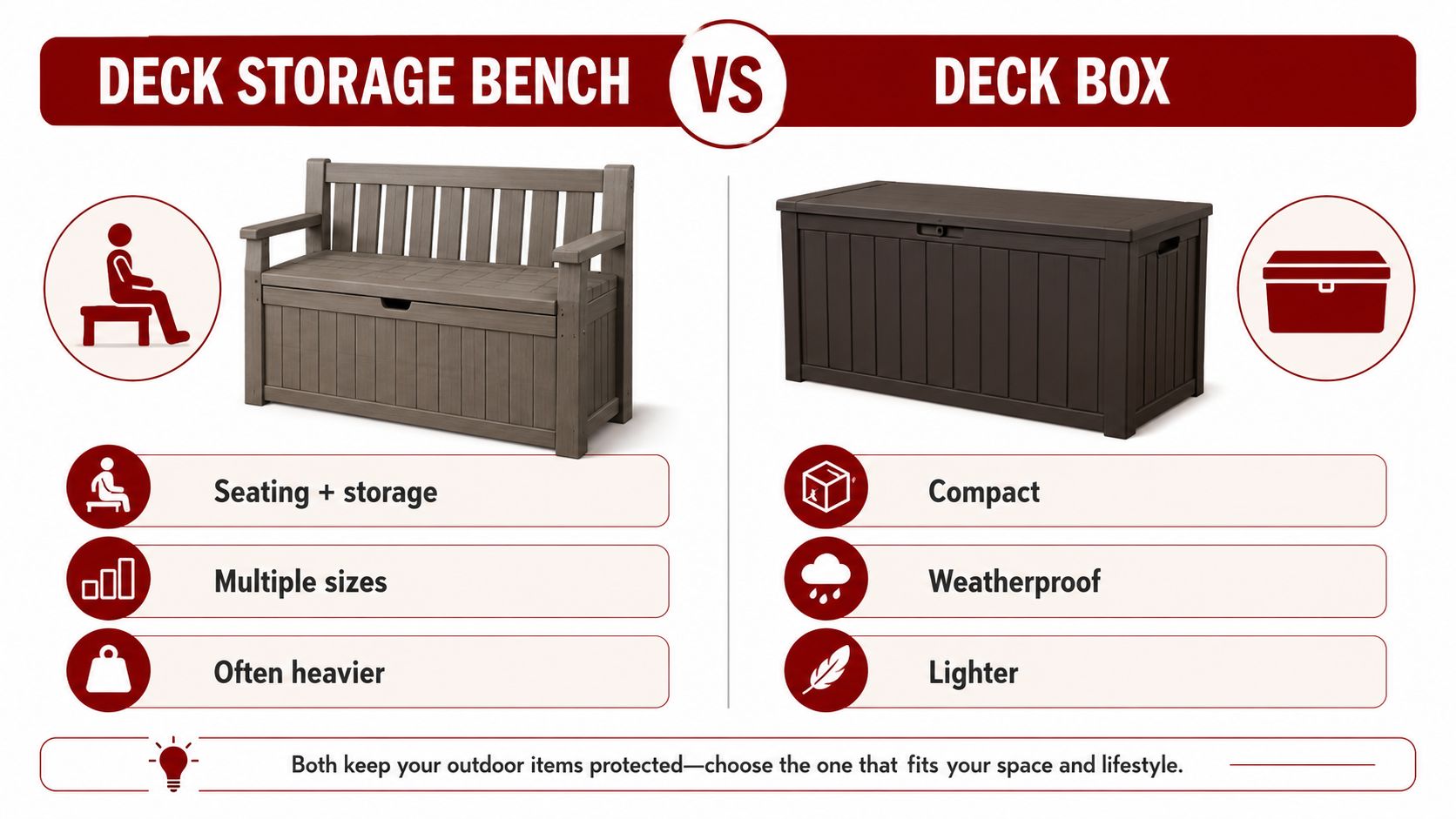
A lot of homeowners in Guelph shop for a deck storage bench when what they really need is a deck box, or the other way around. The difference is simple once you look at how the piece is meant to be used. A storage bench is seating-first, with hidden storage under the seat or inside the bench body, while a deck box is storage-first and may only be used as occasional seating.
The practical effect shows up right away on the deck. A bench changes circulation, because people naturally treat it like a sitting spot and leave room around it. A box, by contrast, usually gets parked against a wall or railing because its main job is to swallow cushions, toys, or tools.
The easiest way to classify your need
If you need another place for people to sit at the table, start with a bench. If you mainly need a dry bin for cushions and loose items, start with a box. That sounds obvious, but it's the mistake behind a lot of cramped decks.
A bench also changes the feel of the space because it acts like furniture, not just storage. It usually has a more deliberate seat height, a more obvious front edge, and sometimes a back or arm detail that makes the deck feel finished. A box can be useful, but it rarely helps the deck read as a living space.
Practical rule: if the item has to earn its place by adding seating, choose a storage bench. If it only needs to hide clutter, a box is usually the cleaner fit.
Typical storage bench capacities often sit in the 70 to 80 gallon range, with some models reaching 100 gallons for larger storage needs, which lines up with the broader outdoor-furniture market in Canada where backyard spending keeps supporting this category. That matters because the bench isn't a niche gadget, it's part of how homeowners are furnishing decks as living space rather than treating them like bare platforms. The Canadian patio furniture market was reported at about USD 2.0 billion in 2023 and forecast to reach roughly USD 3.0 billion by 2030, with a CAGR near 5.9%, which supports why storage benches keep showing up as a core deck add-on in Canada. Grand View Research market context as cited in the provided brief
Built-In Versus Freestanding Storage Benches
The first real decision isn't material, it's whether the bench belongs to the deck or to the furniture plan. A built-in bench ties into the framing and usually looks intentional from day one. A freestanding unit can be moved, swapped, or brought inside without touching the deck structure.
A built-in makes sense when the deck is tight and every inch has to work. It can wrap a corner, define a dining zone, or replace multiple loose chairs without adding visual clutter. That's the route I'd lean toward on smaller Guelph decks where the owner wants one clean seating wall instead of a jumble of separate pieces.
A freestanding bench wins when flexibility matters more than permanence. You can pull it away for cleaning, shift it for a party, or replace it later without reworking the deck. That's a real advantage on resale-focused properties, because a future buyer may love the idea of storage, but hate a fixed feature that locks the layout in place.
Code and resale are part of the choice
Ontario homeowners are dealing with a 2024 Ontario Building Code update that expanded provisions around safety guards, structural design, and prescriptive deck requirements. That doesn't automatically mean every bench needs a permit, but a built-in that's attached to the deck structure is no longer a casual furniture decision. If the bench affects framing, guards, or structural details, it belongs in the drawing set and the conversation with the builder.
A freestanding bench avoids some of that complexity. It still needs to be stable and appropriately sized, but it doesn't usually change the deck's structural paperwork in the same way. For homeowners who want less red tape and more flexibility, that's often the cleaner path.
A fixed bench can make a small deck feel bigger, but only if you're sure the layout won't need to change later.
I once saw a Guelph homeowner ask for a wraparound bench in a permit sketch, then realise halfway through design that it narrowed the path to the stairs more than they expected. We adjusted the plan before anything was built, because that's the point where fixed seating should be judged, while it's still lines on paper rather than lumber on site. For a useful framing reference on wood choices before you settle on a built-in, the material discussion in this decking wood guide is worth a look.
This decision also affects what the deck feels like in August versus January. A built-in bench can be custom-fitted and visually clean, but a freestanding bench can disappear when the season turns and you want the space open. That trade-off is the core one, permanence versus flexibility, not style versus style.
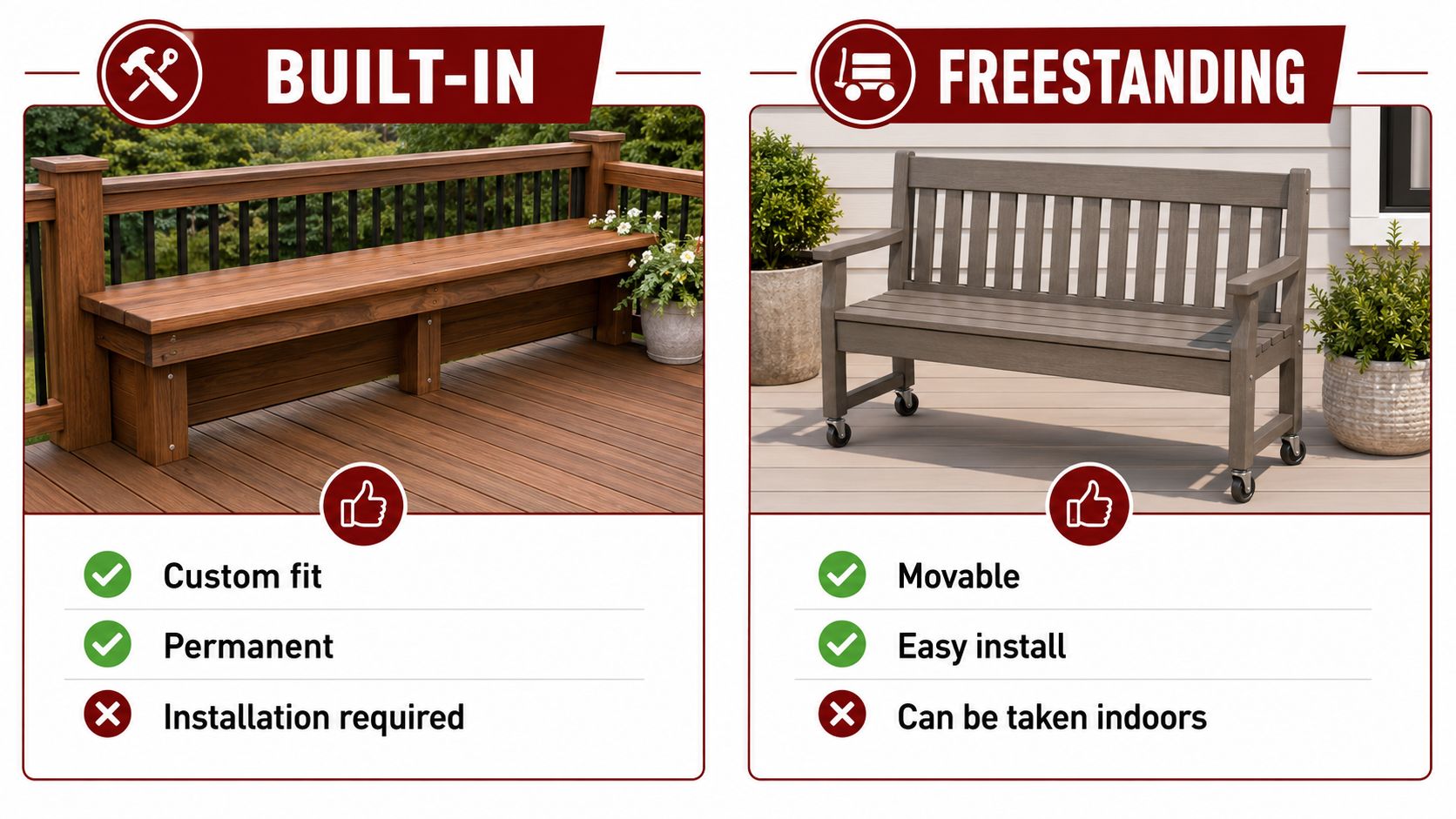
The built-in route asks more of the layout, the drawings, and the framing. The freestanding route asks less of the deck, but more of the furniture itself, because it has to stand up to being moved and shifted around. If the deck is small and you want the bench to do real work, built-in has the edge. If the deck is larger or resale flexibility matters, freestanding usually makes more sense.
Here's the embedded guide video for homeowners comparing fixed and movable outdoor seating choices.
Material Choices for Guelph Decks
Cedar, composite, vinyl, and pressure-treated wood all behave differently once they're asked to do double duty as seating plus storage. A bench that only has to look good on a showroom floor can get away with a lot. A deck storage bench sitting through Guelph weather can't.
What each material is really good at
Cedar gives you the warm, natural look most homeowners want when the bench is part of a visible deck composition. It feels right in a backyard with planting beds, planters, or a more traditional deck design. The catch is maintenance, because wood moves, checks, and needs care if you want it to stay attractive.
Composite is the low-maintenance choice that many homeowners reach for when they want less staining and less upkeep. It handles routine exposure well, but enclosed storage still needs smart detailing because a sealed cavity can trap moisture. It's a strong pick when the goal is tidy, predictable ownership.
Vinyl tends to do well on shaded lots where direct sun and constant touch-up work become annoying. It's also forgiving in the sense that you're not chasing the same finish maintenance cycle as with natural wood. The downside is that it can look less custom unless it's installed carefully and matched to the rest of the deck.
Pressure-treated wood usually wins on upfront value and availability. It's the material that lets a homeowner get moving without overcommitting the budget. It's also the one that rewards decent detailing, because if the cuts, fasteners, and drainage aren't handled properly, the bench will remind you quickly.
My builder's bias: cedar for look, composite for convenience, vinyl for low-touch durability, pressure-treated for the best value when the design is kept simple.
Material Comparison for Deck Storage Benches | Maintenance | Moisture Behaviour | Typical Cost Tier |
|---|---|---|---|
Cedar | Moderate to higher | Needs care in enclosed spaces | Premium |
Composite | Low | Resists weather, still needs drainage detail | Mid to premium |
Vinyl | Low | Handles exposure well, especially in shaded use | Mid to premium |
Pressure-treated wood | Moderate | Can work well if sealed and detailed correctly | Budget to mid |
For a homeowner deciding between a natural look and lower upkeep, it helps to think in terms of how the whole deck will age, not just the bench. If the rest of the space is already wood-heavy, cedar can feel integrated. If the deck is meant to stay simple and practical, composite or vinyl usually keeps the maintenance load lighter.
If you're choosing the bench to echo planting and border details rather than become a focal point, the ideas in MyGardenGPT backyard deck design can help you see how the bench fits into the rest of the outdoor layout. That kind of visual coordination matters because a storage bench is too large to treat as an afterthought.
Sizing, Load Capacity, and Framing Considerations
A bench that looks light on a product page can still punch hard on a deck. The reason is simple, load is concentrated, and a seated person plus stored contents don't spread out the way patio furniture marketing photos suggest they do. Once the bench sits on a deck, its footprint becomes a structural question.
Read the spec sheet like a builder
Seat height, depth, and length matter first for comfort, then for framing. A seat that's too low gets awkward to use, while a bench that's too deep starts swallowing circulation space. The common practical range shown in product visuals is 18 to 20 inches high, 20 to 24 inches deep, and 48 to 72 inches long, with static load capacity shown at up to 500 lb in one representative layout. Those numbers are useful as a starting point, but they're only half the story.
A common resin model is rated for 500 lb while weighing only 31.97 lb, and another 80-gallon resin bench is rated for 550 lb at 44.1 lb dead load. That means the bench itself can account for roughly 6 to 9% of its rated carrying capacity before anyone sits down or stores anything inside, based on the figures in the provided retail examples. In plain terms, a unit that feels light in your hands can still become a meaningful point load on joists.
Where the bench should sit
If the bench is going on an elevated deck, I want it over framing members or blocking whenever possible. Mid-span placement can make the deck work harder than it needs to, especially if the bench will hold dense contents like tools, patio weights, or bagged supplies. A person sitting, plus the bench itself, plus whatever's stored inside, all stack into one area.
Practical rule: if the bench is heavy when empty, treat it like a structural fixture, not movable furniture.
That's why a built-in bench often needs the builder involved before construction starts. The fasteners, support points, and blocking all need to be planned so the bench doesn't create a soft spot in the deck later. A quick conversation during design can save a lot of frustration after the first season.
For homeowners, the best habit is to compare the bench spec sheet against the deck framing plan. If the bench is going to be long, full of dense items, or used by multiple adults at once, the structure under it matters as much as the finish on top.
Moisture Management in Ontario's Freeze-Thaw Climate
Ontario is hard on anything that traps water. Guelph gets wet shoulder seasons, freezing nights, and thaw cycles that test lids, hinges, and stored cushions far more than a dry climate would. A bench that looks “weather resistant” in a product listing can still fail if moisture has nowhere to go.
The real failure mode is trapped dampness
The problem usually isn't a single downpour. It's the damp cushion that goes back into the bench, the hinge cavity that never fully dries, or the bit of standing moisture that freezes and expands at the wrong time. That's where lids start binding, hardware starts corroding, and mildew starts showing up in the contents.
Ontario's building rules also point in the same direction. The province's code requires an “adequately protected” building envelope against precipitation, snow, and ground moisture, which is a good reminder that water management is part of durability, not an optional detail. If the deck is exposed and snow collects directly on the bench, the enclosure needs drainage, ventilation, or a different product choice altogether.
What to do with a bench cavity
A bench should be raised, vented, or skipped depending on exposure. If the site catches wind-driven rain, the cavity needs a way to dry out. If the deck sits fully open and takes regular snow cover, I'd be cautious about any closed storage that holds cushions through winter.
For homeowners looking at outdoor installations where weather exposure is a concern, the wet rated outdoor lighting guide is a good reminder that outdoor products live or die by their environmental rating, not by their marketing language. The same thinking applies here, because “water-resistant” doesn't mean trouble-free in a freeze-thaw zone.
The best detail is often simple. Leave a path for water to escape. Don't store damp fabric in a sealed cavity. Choose hinges and hardware that can survive repeated seasonal movement. If the bench can't dry, it's not a storage solution, it's a moisture trap with a lid.
DIY Installation Versus Hiring a Deck Builder
A flat-pack resin bench is a weekend project. A built-in cedar bench with a hinged lid is carpentry, and there's no point pretending otherwise. The difference shows up in layout, fastening, and whether the job needs permit-ready drawings before a tool ever comes out of the truck.
What DIY does well
DIY makes sense for freestanding benches, especially resin or lighter composite units that arrive pre-shaped and mostly assembled. If the bench just needs to be unboxed, levelled, and maybe anchored lightly for stability, a capable homeowner can usually handle it. The risk stays low because the deck structure isn't being changed.
DIY starts to wobble when the bench becomes part of the deck itself. Once you're cutting into framing, tying into existing structure, or adding a built-in lid and support hardware, the job stops being simple assembly. That's also the point where mistakes become expensive because they affect the deck, not just the furniture.
What a professional adds
A builder brings the permit drawings, the fastening plan, and the judgement about where the bench should land on the framing. That matters if the bench is fixed, heavy, or integrated into the deck's edge. It also matters for insurance and warranty, because a homeowner who installs a structural bench themselves carries more of the downside if something goes wrong.
For a broader look at how homeowners weigh installation and security decisions before hiring, the article on compare home security options in Australia is a useful parallel. Different category, same logic, the more permanent and consequential the install, the more you want proper planning rather than a quick shortcut.
A good DIY job saves money. A good professional job saves you from redoing the same work after one wet season.
The clean decision rule is this. If the bench is freestanding and low risk, DIY is fair game. If the bench is built in, tied to the deck, or part of a permit conversation, hire a deck builder who can handle the structural details properly.
Realistic Cost Ranges for Guelph Homeowners
Bench pricing online can be wildly misleading because it often leaves out the stuff that changes the final number. Material, hinge quality, drainage detailing, labour, and permit drawings all move the total. That's why a cheap-looking bench on a website can turn into a very different number once it's adapted for a real deck in Guelph.
What drives the price
Entry-level resin usually stays the easiest to budget for because the unit is manufactured, not built on site. It's the route most homeowners take when the goal is simple storage with occasional seating.
Mid-range composite sits higher because the material itself costs more and the finish tends to be more refined. This is the zone for homeowners who want lower upkeep without jumping straight into custom carpentry.
Premium cedar built-ins cost more because you're paying for lumber, joinery, hinges, and on-site fabrication. The upside is a more integrated look, especially when the bench needs to follow the deck shape.
Fully custom cedar or composite built-ins installed by a local deck builder cost the most because they usually include design time, labour, and permit-ready drawings. That's also where the bench starts acting like a true part of the deck rather than a separate object.
The provided cost breakdown graphic lists materials at 40%, labour at 35%, and markup at 25%, with a note of $50/hr local labour rate and tiers shown as Budget $200 to $400, Mid-range $400 to $800, and Premium $800 to $1,500. Those figures are useful as a way to read a quote, not as a promise for every job. They tell you where the money usually goes and what kind of bench each tier tends to support.
When you compare quotes, ask whether hardware, lid supports, drainage details, and permit drawings are included. That's where apparently similar bids stop being similar. A lower price isn't a better price if it leaves out the parts that keep the bench usable after the first winter.
Permits, Code, and Your Next Steps in Guelph
A bench feels like furniture until it becomes part of the deck structure, then it starts behaving like construction. That's the line Guelph homeowners need to respect, especially when a built-in bench affects framing, guards, or the way the deck is documented for approval. The Ontario rules around deck design keep getting more specific, and that makes casual add-ons less casual than they used to be.
For a practical overview of what those rules mean for homeowners, the local guide to deck building codes in Ontario is worth checking before you commit to a fixed design. It's a lot easier to adjust a layout on paper than to discover a permit problem after the bench is already built.
Quick answers before you call a contractor
What capacity is usually enough? For many patios, the common bench range in the earlier section is a solid starting point, but the right number depends on how many people will sit and what you plan to store.
Are child-safe hinges worth it? Yes, if the lid can close unexpectedly or if children use the space. Soft-close hardware reduces the chance of slammed fingers and makes the bench easier to live with.
Should it be anchored to the deck? If it's freestanding, maybe not. If it's built in or heavy enough to move framing loads around, anchoring and blocking should be part of the design.
If you want the bench to feel like part of the deck and not a compromise, get the structure and the paperwork right first. Then choose the finish, because the finish only matters when the bench is still sound after the weather has done its worst.
If you're weighing a built-in bench against a freestanding one, Guelph Deck Builders can help you sort out the framing, code, and layout details before you commit. Visit Guelph Deck Builders to talk through a deck storage bench that fits your space, your winter conditions, and the way you use your backyard.
Comments