
Deck Paint vs Stain: A Guelph Homeowner's Guide

You're standing on the back deck in Guelph after the snow has finally gone, and the boards tell the truth before you do. Maybe the finish is blotchy, maybe the colour has gone grey and tired, or maybe last year's coating is already lifting at the edges. That's the deck paint vs stain decision, not a branding debate, but a question of what your deck can handle after an Ontario winter.
If the deck is newer, in decent shape, and you want a more durable film on top, paint can make sense. If the wood is weathered, moving with moisture, or already showing old coating failure, stain usually gives you the cleaner path forward. In Guelph, that matters because freeze-thaw, spring dampness, and summer sun punish the wrong finish fast, especially on horizontal boards that hold water and take foot traffic all season.
Factor | Deck Paint | Deck Stain |
|---|---|---|
Surface look | Opaque, uniform colour | Natural wood grain shows more |
Failure pattern | Peeling, chipping, cracking | Fades or wears thin |
Prep burden | Heavier, more demanding | Cleaner surface needed, but more forgiving |
Renewal cycle | Longer between refinishing | Shorter, easier to refresh |
Best fit | Sound wood, strong prep, colour change | Weathered wood, easier upkeep |
Table of Contents
Why This Decision Matters More in Guelph - The deck doesn't care what the can says - Material and age change the answer
What Paint and Stain Actually Do to Wood - Paint makes a film, stain works into the grain - Stain isn't one product, it's a range
Longevity, Maintenance, and Real Cost Over Time - What the numbers show - The interval matters more than the sticker price
Prep and Application Differences That Decide the Outcome - Paint needs a cleaner slate - Stain gives you a little more forgiveness
Matching Finish to Deck Material - Cedar and pressure-treated lumber need different thinking - Composite and vinyl sit outside the wood-finish debate
When Paint Is the Wrong Tool for the Job - Old failures don't disappear under new colour - Know when to strip, and when to stop
A Clear Recommendation for Guelph Homeowners - Match the finish to the deck you actually own - Know when to call a local builder
Why This Decision Matters More in Guelph
A lot of homeowners ask the question in the wrong order. They start with colour chips, then ask whether paint or stain is “better”, after the deck has already survived a winter of moisture, expansion, and contraction. The smarter question is simpler. What condition is the deck in right now, and what kind of finish can survive Guelph weather without turning into a maintenance headache?
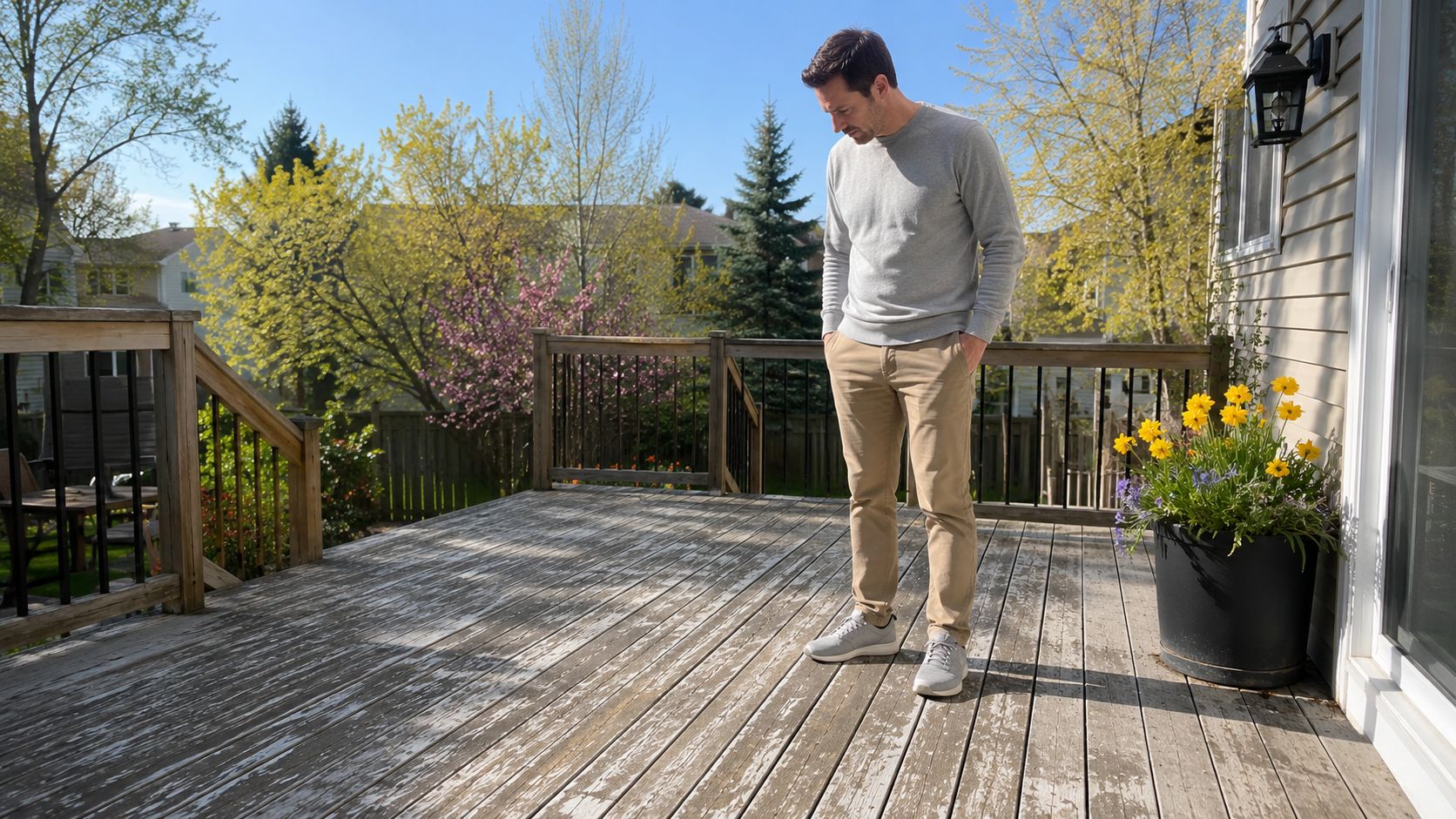
The deck doesn't care what the can says
In Ontario, moisture exposure and weather protection are not optional. The Ontario Building Code sets the baseline for deck construction, and the province requires wood components exposed to moisture or weather to be protected with a suitable finish or preservative approach. That's why a finish choice on a Guelph deck is never just cosmetic. It's part of how the wood survives spring thaw, summer UV, and another wet fall.
Practical rule: If the deck boards are already moving, cupping, or showing past coating failure, choose the finish that works with the wood, not against it.
That's where the climate matters. Paint forms a film, so when wood swells and shrinks, the coating can split or lift. Stain is usually the more forgiving choice on older boards because it penetrates rather than sitting as a rigid shell on top. On a newer, tighter deck, paint can still make sense, but only if the prep is serious and the substrate is stable.
Material and age change the answer
Cedar, pressure-treated lumber, composite, and vinyl do not all behave the same. A cedar deck that has faded but is still sound often wants stain more than paint. Pressure-treated lumber can be a candidate for either, but only after proper seasoning. Composite and vinyl usually sit outside the wood-finish debate altogether, because they need a different maintenance approach.
The point is straightforward. Most “deck paint vs stain” articles flatten everything into a generic pros-and-cons list. A Guelph homeowner needs a decision based on condition first, then material, then the level of upkeep they're willing to live with. If you've got an older deck coming out of its first or second Ontario winter, start there, not with the sales pitch on the shelf.
What Paint and Stain Actually Do to Wood
Paint and stain are not just different colours in different cans. They behave differently at the surface, and that difference controls how the deck looks, how it fails, and how much work you're signing up for later. One sits on top. The other works into the wood.
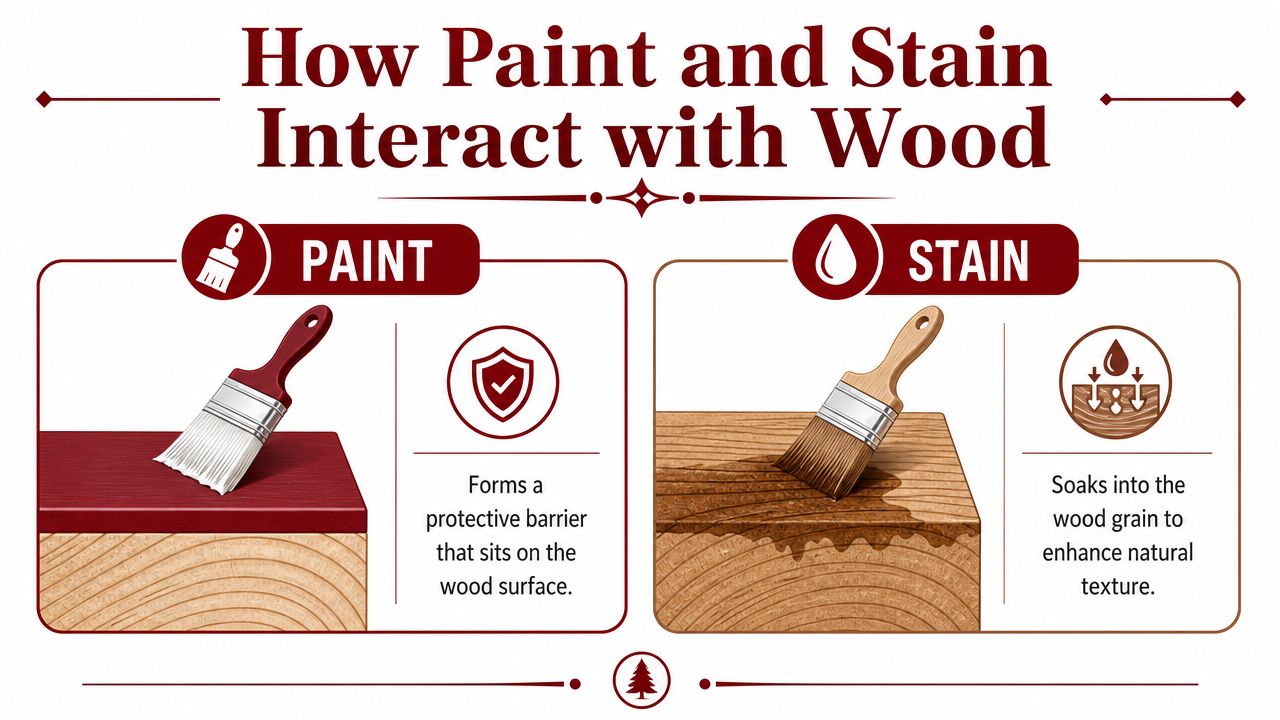
Paint makes a film, stain works into the grain
Paint creates a surface coating. It covers the wood more completely, which is why it can hide colour variation and give you a cleaner, more uniform finish. That same film is also the reason paint becomes a bigger repair job once it starts to fail. When moisture gets under the coating, the damage tends to show up as peeling, cracking, or chipping rather than a simple faded look.
Stain behaves differently. It penetrates the wood fibres instead of building a thick shell over them, so the grain still reads through and the deck keeps a more natural look. The finish usually wears down gradually, which is less dramatic to deal with than a sheet of peeling paint. That's the main reason stain is often the better fit for decks that are already weathered.
Stain isn't one product, it's a range
Homeowners often talk about stain as if it's one thing, but it isn't. You're really choosing among clear, semi-transparent, and solid stain. Clear finishes show the most wood character, semi-transparent gives you a middle ground, and solid stain moves closer to the look of paint while still behaving more like a penetrating wood finish.
A deck finish should be chosen for the deck you have, not the deck you wish you had.
That matters because many older decks need coverage, not a full-on paint film. A solid stain can sometimes give you the colour and concealment people want without crossing all the way into paint's more brittle failure pattern. On a deck with older boards, that distinction can save you from a finish that looks great in May and starts flaking by the next hard season.
The takeaway is plain. If you want the wood grain to remain part of the look, stain is the natural choice. If you want a more opaque surface and you're prepared for heavier prep later, paint can work. The finish only makes sense when it matches the condition of the wood under it.
Longevity, Maintenance, and Real Cost Over Time
Upfront price gets attention. Maintenance decides whether the finish is still a smart choice a few seasons later. On a deck, that gap is usually bigger than homeowners expect, because the cheapest finish today can turn into the most expensive one to live with if it fails badly.
What the numbers show
A national professional-services benchmark cited by Angi puts professional deck staining at about $850 and painting at about $1,000 on average. Product-only guidance from Bob Vila estimates stain at $20 to $35 per gallon and exterior paint at $30 to $60 per gallon, plus about $15 to $40 per gallon for wood preservative and roughly $30 per gallon for primer when painting. Those gaps are not huge on day one, and that is exactly why people get pulled toward the wrong choice. Angi's deck painting and staining cost guide and Bob Vila's deck painting and staining cost breakdown both show that the difference usually shows up later.
The interval matters more than the sticker price
Paint is the longer-interval option for decks. Industry guidance places paint longevity at about 5 to 10 years, and in favourable conditions paint can last up to 10 years or longer. Stain usually sits in the 2 to 8 year range depending on product type and exposure, with some guidance putting renewal closer to 1 to 3 years if appearance retention is the priority. Sherwin-Williams, Angi, and ZAR all point in the same direction, paint lasts longer between full refinishes.
Longer service life still does not make paint the better buy in every case. Paint only pays off if the film stays bonded. Once it starts to fail, the repair is usually rougher and more labour-heavy than refreshing stain. Stain wears down more gradually, so the next coat is easier to live with.
Cost reality: If you expect to own the house for years and you hate maintenance, paint is tempting. If you want easier upkeep on older boards, stain usually wins the practical test.
The clean way to think about it is simple. Spend a little less now for stain, and accept more frequent refreshes. Spend more upfront for paint, and accept that the future prep can be much harsher. If the deck is already in rough shape, the cheaper product is often the one that does not need a rescue later.
For older cedar decks, that decision usually gets even clearer. A detailed look at cedar deck staining practices shows why wood condition and moisture exposure matter so much before you choose a finish.
Factor | Deck Paint | Deck Stain |
|---|---|---|
Typical service interval | Longer, often around 5 to 10 years | Shorter, often around 2 to 8 years |
Upfront professional cost | About $1,000 on average | About $850 on average |
Product cost | $30 to $60 per gallon plus primer and preservative | $20 to $35 per gallon |
Failure style | Peeling, cracking, chipping | Fading, thinning |
Maintenance feel | Bigger jobs, less often | Smaller refreshes, more often |
Prep and Application Differences That Decide the Outcome
Prep is where most deck jobs are won or lost. People love arguing paint versus stain, but the problem on Ontario decks is usually that the surface was never ready for either one. If the wood is dirty, damp, flaky, or still carrying the scars of an old coating, the finish is starting from behind.
Paint needs a cleaner slate
Paint wants a disciplined prep sequence. Strip what's failing, sand the board faces, patch problem spots, prime where needed, then apply the finish in a way that gives it real adhesion. If the deck still has old paint hanging on in loose sheets, the new coat is just borrowing trouble.
That's why a deck with damp spring boards is a poor candidate for paint. A film coating hates trapped moisture. If the wood is still drying out after a wet spell, the finish can lock that moisture in and invite early failure. The board may look dry at the surface and still be holding enough moisture underneath to cause trouble later.
Stain gives you a little more forgiveness
Stain still needs prep, just not the same degree of perfection. Cleaning, sanding, and letting the deck dry properly matter, but stain is more forgiving of minor imperfections because it soaks in rather than sitting as a brittle layer. That's why a weathered deck can often be brought back more cleanly with stain than with paint.
For homeowners in Guelph, the usual weak spots are board ends and fastener zones. Those areas take on water first and release it last. If you see checking, lifted fibres, or darkened edges around screws, treat those as warning signs before you choose a finish. A new coating won't fix bad wood movement.
If you're on the fence, stand on the deck after a wet morning and inspect the end grain. That's where the finish usually gives up first.
For a cedar deck specifically, a local walk-through like the one in this cedar deck staining guide is worth a look because the material and the finish have to be matched properly. The same logic applies to pressure-treated lumber, which needs time to season before either finish is trustworthy. This pressure-treated wood overview is a good reference point if you're not sure what you're standing on.
A solid prep job doesn't guarantee success, but skipping it all but guarantees failure. Paint punishes shortcuts more aggressively. Stain is more forgiving, but it still won't save a deck that's dirty, wet, or structurally tired.
Matching Finish to Deck Material
The deck material decides more than many admit. Cedar, pressure-treated lumber, composite, and vinyl all ask for different handling, and some of them don't really belong in the paint versus stain conversation at all. If you start with the wrong material assumption, you end up shopping for the wrong finish.
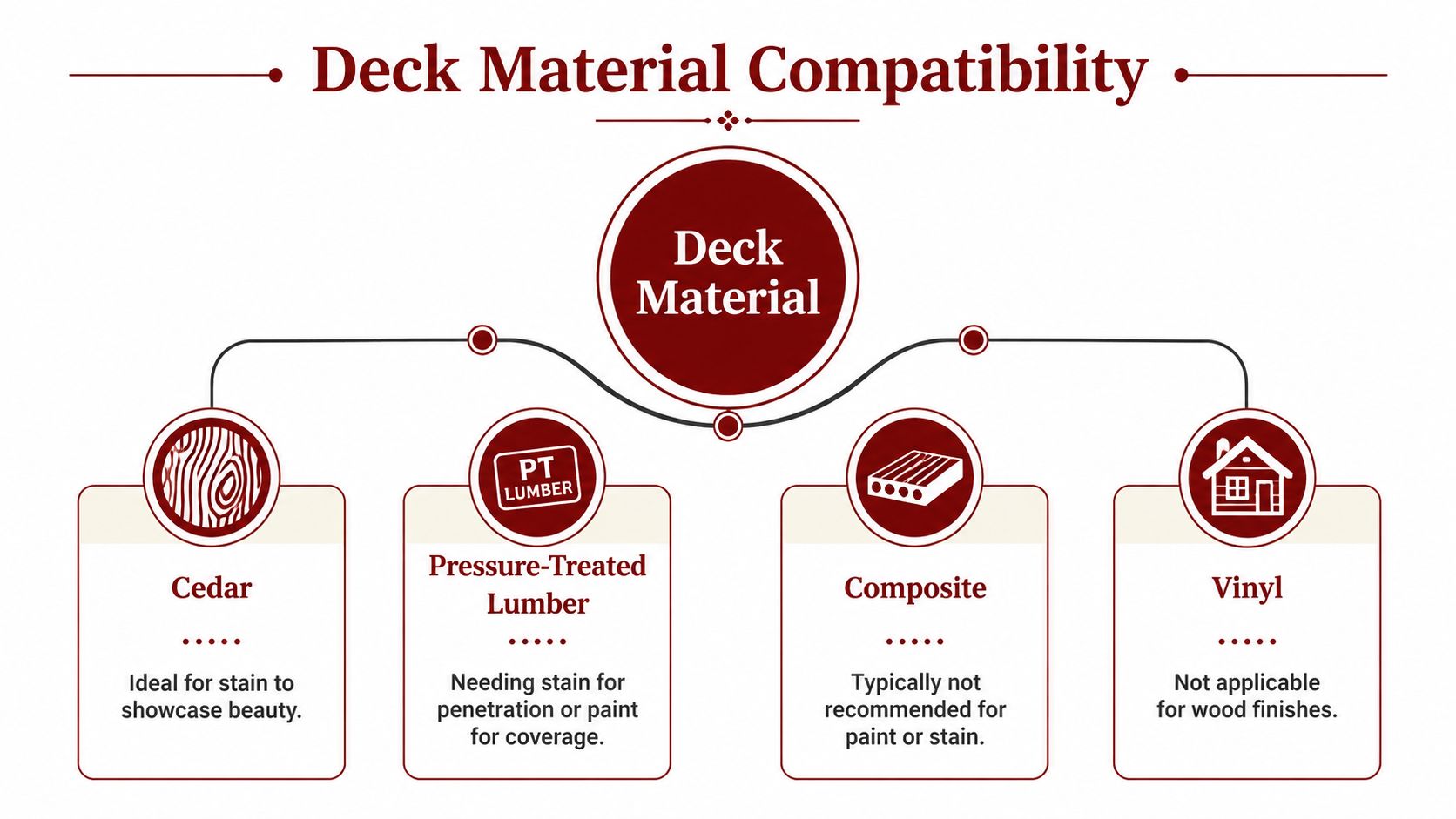
Cedar and pressure-treated lumber need different thinking
Cedar usually looks its best with stain, especially semi-transparent stain, because the grain stays visible and the wood keeps its character. Paint can cover cedar, but it also covers what makes cedar worth using in the first place, and any future failure tends to be more obvious. That's why cedar decks are often better treated as finish-sensitive wood, not as a blank canvas for opaque coating.
Pressure-treated lumber is more flexible, but it still needs time. Fresh pressure-treated boards should season before finishing, otherwise the coating can struggle to bond properly. Once the wood is ready, stain is often the easier choice for a lower-prep refresh, while paint makes sense when the homeowner wants a more covered look and is willing to accept the maintenance trade-off.
Composite and vinyl sit outside the wood-finish debate
Composite doesn't usually belong in the stain aisle, and it's not where I'd point a homeowner for paint either. It's a manufactured deck board, not a bare wood surface. Vinyl is similar in the sense that wood finishes aren't the right starting point. If you're working with either material, the maintenance plan is different, and surface coatings are usually not the answer.
Useful shortcut: If the deck board isn't real wood, stop assuming a deck stain can solve it.
That's where a broader planning resource like BIM for wood framing can help homeowners and builders think through structure, not just surface finish. Finish choice should follow the build material, not fight it. In a real deck project, that distinction keeps you from spending on a coating that doesn't suit the substrate.
The cleanest rule is simple. Cedar often leans stain. Pressure-treated lumber can go either way after proper seasoning. Composite and vinyl need a different maintenance conversation. If you're not sure what you have, the wrong finish is an expensive guess.
When Paint Is the Wrong Tool for the Job
Paint has a loyal following because it can look sharp on day one. On an older deck, though, that's often exactly the trap. Horizontal exterior wood in a freeze-thaw climate is hard on paint, and a deck that already has weathering, cupping, or a failed coating is usually telling you that a film finish is the wrong next move.
Old failures don't disappear under new colour
A failing painted deck rarely needs more paint. It needs honesty. If the old coating is peeling or cracked, the new coat is only as good as the surface underneath it, and on horizontal boards that's a big problem. The more the wood moves with weather and moisture, the more likely the film is to split again.
Professional guidance in the field notes that paint is generally discouraged on horizontal exterior wood surfaces exposed to weather, while stain is preferred because it handles foot traffic and moisture better. That line matters in Guelph because repeated freeze-thaw cycles make trapped moisture and brittle coatings a bad combination. If the deck has already been through winter after winter, a solid stain or restoration-style finish is often the smarter answer than another coat of paint. Legacy Painting's guidance on deck painting versus staining makes that distinction clearly.
Know when to strip, and when to stop
An old painted deck can sometimes be saved, but not always cheaply. If the coating is broadly failing, stripping back to bare wood may be the honest answer before any new finish goes on. If the boards are soft, badly checked, or structurally tired, stripping might just confirm what the deck already needs, replacement.
Homeowners lose weekends. They keep arguing paint or stain when the deeper issue is that the deck's surface has aged past a simple cosmetic fix. A solid stain can sometimes bridge the gap, especially when you need coverage without the brittleness of paint. But if the wood itself is compromised, no finish will make it sound.
The hard call is often the right one. If the deck is weathered but still structurally decent, go with a finish that breathes and wears gracefully. If the existing paint is the problem, don't throw more paint at it and hope for a different result.
A Clear Recommendation for Guelph Homeowners
Here's my straight answer. If the deck is newer, the wood is sound, and you want a more opaque look, paint can work, but only with proper prep and the acceptance that future repairs may be more involved. If the deck is older, weathered, or already showing finish failure, stain is the better default because it's easier to live with in a freeze-thaw climate.
Match the finish to the deck you actually own
A new pressure-treated deck can usually take stain once it has seasoned, or paint if you're committed to the maintenance. A faded cedar deck usually deserves stain, especially semi-transparent or solid stain depending on how much character you want to keep. A composite deck needs a separate maintenance plan, not a wood-finish decision. A vinyl surface isn't the place for deck paint or stain at all.
If the budget is tight and the deck is being refreshed before a sale, stain is usually the cleaner move because it improves appearance without creating the same future repair burden. If the deck is structurally worn, don't dress it up first and ask questions later. Get the condition checked before you spend on finish.
Know when to call a local builder
A deck builder should be on the table when the boards flex, the railings feel loose, or the surface damage looks structural instead of cosmetic. Guelph Deck Builders handles consultation, design, permit-ready drawings, and installation for cedar, composite, vinyl, and pressure-treated wood, so that's a practical route when the deck needs more than a new coat and a Saturday afternoon. If the finish question is really hiding a rebuild question, solve the rebuild question first.
Don't spend good money on a coating for a deck that's telling you it wants repair.
My recommendation is simple. For most older Guelph decks, choose stain, not paint. For newer decks with stable boards and a clear maintenance plan, paint can still be justified. The key is condition, not preference.
If your deck is peeling, faded, or overdue for a real decision, talk with the team at Guelph Deck Builders. They handle deck assessment, material guidance, and wood-deck solutions that fit Guelph's climate, so you can stop guessing and choose the finish or rebuild path that makes sense for your back porch.
Comments