
Deck Cost Per Square Foot: A Guelph Homeowner's Guide

You've got two quotes in your inbox, both for what looks like the same deck, and one of them makes your stomach drop. One builder says the number is sensible. The other looks almost too good to be true. That's usually the moment Guelph homeowners realise deck cost per square foot is useful, but only if you know what's inside that number.
A square-foot price sounds clean because it gives you a fast way to compare quotes. The problem is that decks aren't built from one clean number. They're built from framing, footings, boards, stairs, railings, fasteners, labour, site conditions, and all the little decisions that turn a rough estimate into the final bill.
If you're trying to budget a new deck in Guelph, stop thinking in terms of one magic price. Start thinking in layers. The footprint gives you the starting point, but the quote you should trust is the one that tells you what's included, what's excluded, and what the builder is assuming about your site.
Table of Contents
Why Two Quotes for the Same Deck Can Differ by Thousands - Why the same footprint doesn't mean the same price
What Goes Into a Per-Square-Foot Price - Material-only and fully installed are not the same thing - The parts you should see broken out
Comparing Cedar, Composite, Vinyl, and Pressure-Treated Wood
Sample Calculations for Real Guelph Deck Sizes - A 200-square-foot deck - A 400-square-foot deck
The Hidden Line Items That Push Your Quote Higher - What moves the number up fast
Questions to Ask Before You Sign a Deck Contract - The questions that expose a weak quote
Maintenance, Lifespan, and Return on Investment Over 20 Years - Think beyond the installation day
Why Two Quotes for the Same Deck Can Differ by Thousands
You can lay two quotes on the kitchen table, stare at the same 300-square-foot footprint, and still feel like you're comparing different jobs. One contractor might be pricing a simple platform with pressure-treated framing. Another might be baking in better hardware, heavier structural work, and a cleaner finish. Neither is automatically playing games.
The reason deck cost per square foot became the standard is simple. It lets homeowners compare projects on the same measuring stick. In Canada, ARGA puts a practical installed benchmark at about $30 to $100 per square foot for homeowners comparing materials and labour, and that same range means a 200-square-foot deck can start around $6,000 and climb to about $20,000 at the high end, while a 400-square-foot deck lands roughly between $12,000 and $40,000. ARGA's Canadian deck cost guide makes the point clearly, the footprint matters, but the build inside that footprint matters more.
Why the same footprint doesn't mean the same price
A builder quoting low might be stripping the job down to the bare minimum. A builder quoting high might be including the stuff that keeps the deck straight, safe, and code-compliant for years. That spread is why a 300-square-foot deck can land at one number from one contractor and a very different number from another without either one lying.
Practical rule: If a quote only gives you a blended square-foot number, you still don't know what you're buying.
The cleanest way to read these quotes is to ask one question, then force everything back to scope. Is this a material-only figure, or a fully installed price with structure, hardware, labour, and finishing? Once you know that, the quote starts to make sense. Until then, the number is just a headline.
What Goes Into a Per-Square-Foot Price
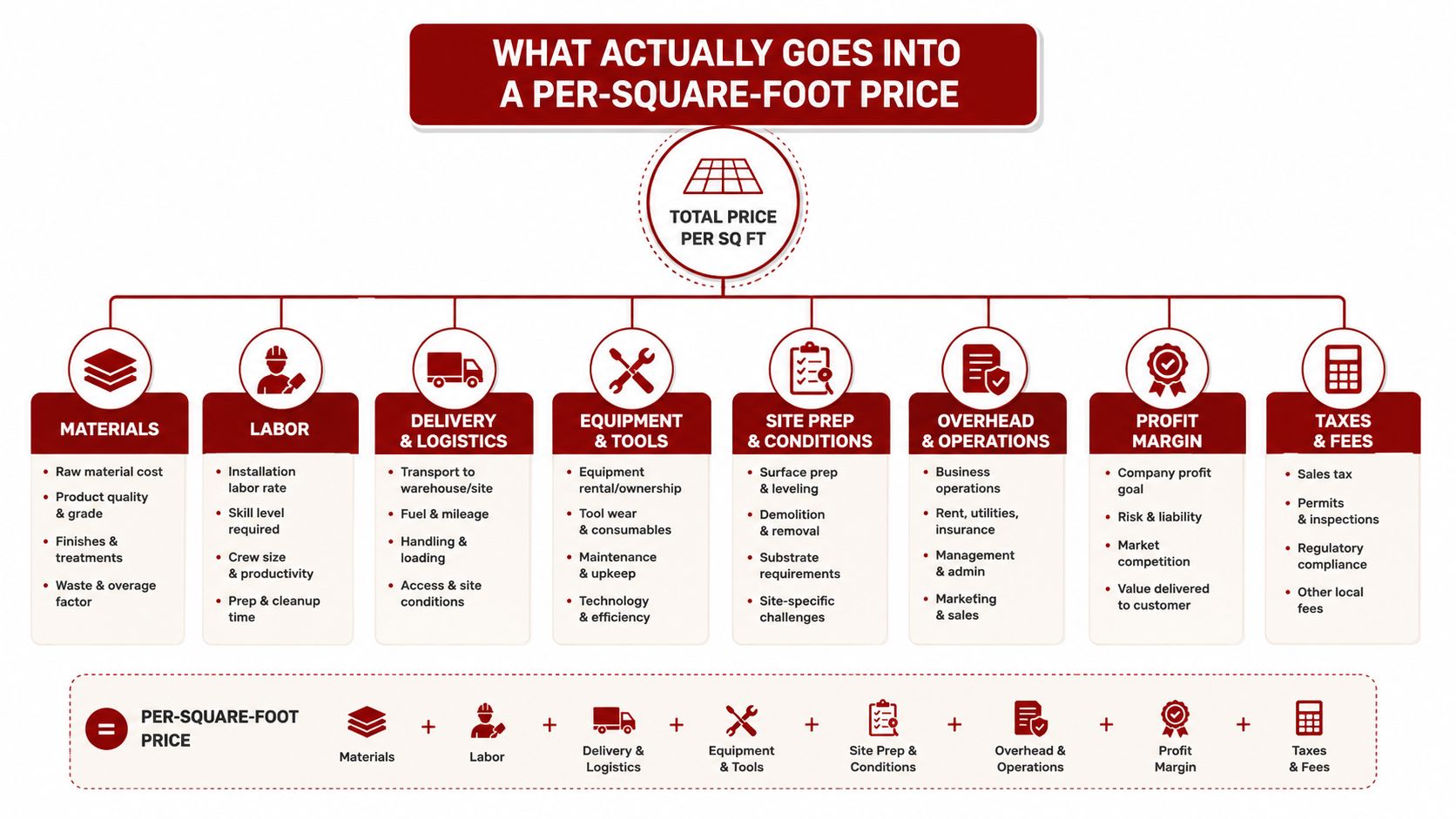
A per-square-foot quote is only the final number on the page. Under that number sit the framing, the deck boards, the fasteners, the labour, and the site conditions that decide how hard the crew has to work. A simple ground-level platform is one job. A raised deck with stairs and railings is another.
Material-only and fully installed are not the same thing
Trex's composite deck guide estimates $21 to $30 per square foot for composite materials alone, including substructure, decking, hardware, and fasteners, and says labour typically accounts for about two-thirds of total project cost. Trex also reports installation labour for composite decks commonly runs $55 to $70 per square foot. Trex's deck cost guide makes the gap clear, material pricing and installed pricing are two different conversations.
That gap matters on a real job. A homeowner comparing a material-only number to a finished quote is not comparing the same scope. For a 300-square-foot composite deck, the material-side numbers alone can land around $6,300 to $9,000, before labour enters the picture. Stairs, railings, drawings, and site preparation all push the final bill higher.
The parts you should see broken out
A proper quote should separate the job into pieces:
Structure and subframe. This is the skeleton. It is the part nobody sees, and the part that gets blamed when corners are cut.
Decking surface. This is the visible finish, whether that is wood, composite, or vinyl.
Fasteners and hardware. Cheap fasteners are a false economy. They save pennies and create headaches.
Labour. Experience shows up here. Good labour is not just faster, it is straighter, safer, and less wasteful.
Stairs, railings, and finishing. These often sit outside the base square-foot number, which is exactly why homeowners get surprised.
Ask for the line items, not the slogan. If the quote cannot survive that request, it was not detailed enough.
A quote should read like a build plan, not a sales pitch. If the numbers are broken out clearly, you can see where a contractor is putting money into the structure and where they may be trimming quality to hit a low headline price. That is the difference between a fair bid and a padded one.
For a local comparison of material choices, read this deck material options breakdown before you compare bids. Understanding this breakdown helps you read any quote with confidence.
Comparing Cedar, Composite, Vinyl, and Pressure-Treated Wood
Material | Installed Cost per Sq Ft | Maintenance | Lifespan | Best For |
|---|---|---|---|---|
Pressure-Treated Wood | $15 to $35 | Regular cleaning, sealing, and occasional board replacement | Shorter than low-maintenance alternatives | Lowest upfront budget |
Cedar | $20 to $40 | Periodic cleaning and sealing | Mid-range natural-wood option | Homeowners who want a warmer look |
Composite | $25 to $50 for mid-grade, $35 to $60 for premium | Low ongoing upkeep | Longer service life than wood in typical use | People who want less maintenance |
Vinyl | Higher-end low-upkeep pricing, often above wood | Low maintenance | Suited to low-maintenance priorities | Homeowners who want a clean, finished look with less care |
Pressure-treated wood is the budget baseline, and it should be. It's the option that gets a lot of Guelph decks built without forcing the project into luxury pricing. National and regional pricing guides consistently place it at the low end, with installed ranges around $15 to $35 per square foot or, in other Canadian and North American guides, about $25 to $50 per square foot for a professionally installed deck. Home Project Calculator's deck cost guide and Realm's pressure-treated deck cost breakdown both point in the same direction, wood is still the cheapest starting point.
Cedar sits in the middle for most homeowners. It costs more than pressure-treated lumber, but it gives you a better natural look without jumping straight into composite territory. That makes it the sensible pick when someone wants warmth and character, but doesn't want to pay premium low-maintenance pricing.
Composite is where the conversation changes. It costs more up front, but the reason homeowners pay for it is simple, they want to stop staining, sealing, and replacing boards as often. The installed ranges in the research place composite around $25 to $50 for mid-grade systems and $35 to $60 for premium products, which is a real jump from pressure-treated wood. Home Project Calculator lays out that gap plainly. On a Guelph lot, that extra upfront spend earns its keep when the owner cares more about lower upkeep than about saving a few dollars at installation.
Vinyl or PVC sits at the high end of the low-maintenance conversation. It's not the budget choice. It's the choice for people who want predictable upkeep and a cleaner ownership experience. In practice, it suits homeowners who'd rather pay more now than keep coming back to refinish a deck.
If you want the short version, here it is. Pressure-treated wood is for the tight budget. Cedar is for the natural look. Composite is for lower maintenance. Vinyl is for the homeowner who wants the least fuss and accepts the higher upfront number.
Sample Calculations for Real Guelph Deck Sizes
A deck quote gets real the moment you put a footprint on paper. A lot of homeowners start with a square-foot number and stop there, then wonder why the final bid is higher once the builder prices the structure, the stairs, the railings, and the site itself. The square-foot figure is still useful, but only if you use it as a starting point, not as the whole job.
A 200-square-foot deck
For a small deck like this, the material choice does most of the work. ARGA's Canadian installed range of $30 to $100 per square foot puts a 200-square-foot deck at roughly $6,000 to $20,000, and that spread is wide for a reason. ARGA's guide gives you the frame, but the final number shifts quickly once you choose between basic pressure-treated lumber and a higher-end finish.
A pressure-treated build stays closer to the bottom of the range because the material is cheaper and the look is straightforward. Composite moves the number up fast, and that is the right trade for homeowners who want less upkeep and a cleaner finish over time. A local composite deck cost guide shows the same pattern in practical terms, the material costs more up front, and you pay for that convenience in the installed price. Labour is a big part of why the total climbs so sharply, because once a deck is built properly, the labour is never a small line item.
A 400-square-foot deck
The same pricing range puts a 400-square-foot deck at about $12,000 to $40,000. The math is simple, but the quote still depends on how much structure the build needs. A plain ground-level platform can stay closer to the lower end, while extra height, more railing, and a harder site push the price upward.
Bigger decks can look cheaper on a per-square-foot basis when the layout is simple, because some fixed work gets spread across a larger surface. That only holds until the design gets more complicated. As soon as the deck needs stairs, more railings, or more structure to sit safely above grade, the square-foot number stops looking friendly.
Use the estimate the way a builder would. First, pick the material class, since pressure-treated, cedar, composite, and vinyl all sit in different price bands. Then decide whether the deck is simple or raised, because that changes the structure and the labour more than most homeowners expect. After that, add the features you need, since stairs and railings are part of the job, not extras you can ignore. Leave room for site-specific work too, because a tight yard, poor access, or awkward grading will show up in the quote whether you planned for it or not.
That is the blunt version. If you know your square footage, the material class, and how much extra work the site demands, you can read a deck quote without getting fooled by a low starting number.
The Hidden Line Items That Push Your Quote Higher
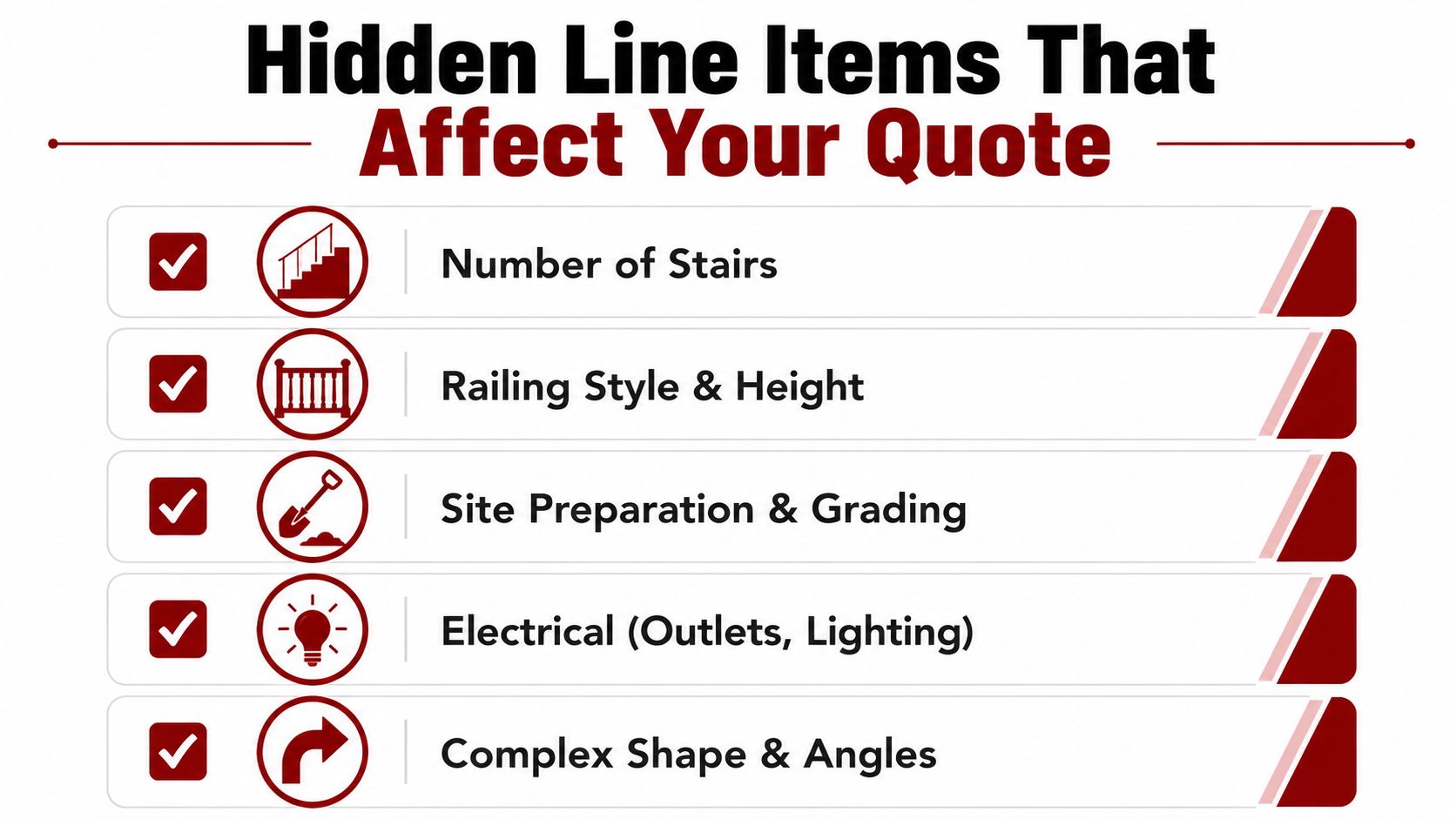
The cheap quote starts to look less impressive. The base square-foot number may look fine, but if it leaves out stairs, railings, demolition, or access issues, you're not comparing a complete job. Ontario pricing guides show that a basic deck can start around $25 to $50 per square foot installed, while second-story, or multi-level decks can jump to $50 to $100 per square foot or more. HomeGuide's deck cost guide makes the spread obvious, and the reason is scope.
What moves the number up fast
Stairs are one of the easiest ways to see a quote climb. They add both material and labour, and the taller the deck sits above grade, the more the design has to account for code and safety.
Railings do the same thing. A straightforward wood railing is one thing. A more refined system with different heights, profiles, or materials changes the cost and the install time.
Height and access matter a lot. Once a deck is raised, the build stops behaving like a simple platform. It starts behaving like a structural project.
Tear-out and disposal also get overlooked. If an old deck has to come down first, the clean-up and hauling are real work, not a favour.
Site conditions can wreck a tidy quote. Tight side access, poor grading, or a slope near the build area make the crew slower. Slow labour costs money.
Rule of thumb: If the quote doesn't mention demolition, access, or grading, ask whether those items are included or assumed away.
Permits and drawings matter too. They're not decorative paperwork. They shape the actual build, especially when the deck is attached, or being replaced. A builder who doesn't talk about them probably hasn't priced the job carefully enough.
The best way to pressure-test a quote is to ask for a scope check. What's included in the base number? What becomes an add-on? What happens if the soil, height, or permit review changes the plan? If the contractor gets vague, the number is probably vague too.
Questions to Ask Before You Sign a Deck Contract
A good deck conversation sounds less like sales talk and more like a job interview. You're not buying lumber. You're buying a finished outdoor structure that has to stand up to weather, code, and years of use. The person giving you the quote should be able to explain exactly what you're paying for.
Start with scope. Ask what's included in the per-square-foot number and what isn't. Then ask whether the quote is for material only or fully installed, because that one detail changes how every other figure should be read.
The questions that expose a weak quote
What's included in the base price? Ask about structure, decking surface, railings, stairs, cleanup, and disposal.
Who handles the permit? If the answer is vague, expect confusion later.
What drawings are provided? Permit-ready drawings are not the same thing as a rough sketch.
What fasteners and structural hardware are you using? Cheap hardware is a red flag on an outdoor build.
What warranty covers labour, and what warranty covers materials? Those are two different promises.
What happens if the site changes after the start? You want to know how change orders are handled before anyone lifts a shovel.
A quote that sits far below the local range without a clear explanation deserves extra scrutiny. That's not smart shopping. That's how homeowners end up paying twice, once for the cheap build and again for the fixes. A builder should be able to explain why their price is low, normal, or high.
Guelph homeowners should also ask who is doing the work and how communication will happen once the job starts. The best builder is not the one who talks the most. It's the one who gives straight answers and then keeps them consistent.
Maintenance, Lifespan, and Return on Investment Over 20 Years
Upfront price gets too much attention. A deck is a long-term ownership decision, and the cheapest installed number can become the most expensive deck if it keeps asking for repairs, staining, and patchwork fixes. Material choice changes the cost of living with the deck, not just the cost of building it.
Think beyond the installation day
Pressure-treated wood usually wins the first round on price, but it demands more upkeep over time. Cedar sits in the middle on cost and gives you a natural finish that many homeowners prefer. Composite and vinyl reduce maintenance, which is exactly why plenty of homeowners accept the higher starting price. Home Project Calculator shows the same basic truth, material selection changes lifecycle cost more than the headline install price.
Practical advice: Buy the deck you want to maintain, not the deck you hope you'll somehow keep up with later.
Resale matters too. A well-built deck can improve curb appeal and help a home show better when it is time to sell. I would never tell a homeowner to build only for resale, but I would tell them not to ignore it. If the outdoor space looks integrated, clean, and durable, buyers notice.
For homeowners who care about the service experience around the build, a helpful model is to turn customer experience into advantage. Clear communication, prompt updates, and a clean handoff matter just as much as the boards themselves.
Over twenty years, the question is simple. Which material leaves you with the least regret? If you hate maintenance, paying more upfront can make sense. If you are comfortable with upkeep and want to stay lean on budget, pressure-treated or cedar may be the smarter call. Raised, second-story, or multi-level decks can push that decision even harder, because the extra structure, access, and railing work raise the installed price before you ever get to the surface material.
Putting Your Budget Together With Confidence
Start with a realistic square-foot band based on material and complexity, not the lowest number you can find online. Then add a contingency of 10 to 15 percent for site surprises and code-driven changes. That cushion is what keeps a small issue from turning into a budget fight.
Next, decide what matters now and what can wait. Stairs, railings, lighting, and a pergola all improve the experience, but not every upgrade needs to happen on day one. If you're balancing the deck against the rest of the yard, a useful read on balancing stone and plants in design can help you think through the hardscape around it, not just the platform itself.
Once you've got your number, get an on-site assessment and ask for permit-ready drawings before work begins. That's the point where a local builder can tell you whether the budget is realistic or whether the site is about to push the project into a different bracket. Guelph Deck Builders handles consultation, design, permit-ready drawings, and installation for cedar, composite, vinyl, and pressure-treated projects, so it's a sensible next step when you want a quote grounded in actual site conditions.
If you're ready to stop guessing and start budgeting with a number that fits your yard, talk to Guelph Deck Builders about an on-site assessment and a quote that breaks out the cost drivers. They can help you compare materials, scope, and permit needs so you can move forward with a deck plan that makes sense for your home and your wallet.
Comments