
Best Composite Decking Material for the Money in 2026

Most homeowners I talk to in Guelph are in the same spot. They've got three quotes, a backyard that still holds frost, and a nagging feeling that the cheapest board on paper won't be the cheapest deck by the time the snow, salt, mud, and sun have finished with it. That's exactly why best composite decking material for the money is the wrong question if you only mean price per square foot, and the right question if you mean installed cost per usable year.
The smartest buy is the board that stays safe underfoot, holds its colour, doesn't turn into a weekend maintenance project, and survives our freeze-thaw cycle without drama. In Ontario, that usually means a mid-priced capped composite instead of the bargain board, and usually not a premium PVC unless the site conditions justify it. If you're comparing deck upgrades with other exterior work, you can also find residential concrete upgrades for a parallel look at how homeowners weigh upfront cost against long-term value.
Table of Contents
Composite Construction Types Explained Simply - Capped composite - Uncapped composite - Hollow profile - Solid profile and PVC-capped hybrids
Lifecycle Cost Over 25 Years in Ontario - What that looks like in real life
Performance in a Guelph Freeze-Thaw Climate - Wet grip comes first - Heat impact is often underestimated - Freeze-thaw is the quiet killer
Matching the Right Board to Your Household - For families with kids - For retirees who want low upkeep - For budget-focused sellers
Warranty, Permits, and Installation Pitfalls - Questions worth asking before you hire
Why Cheapest Board Often Costs More in the Long Run
A homeowner in south Guelph stands in a snow-covered yard with three quotes in hand. One contractor is pushing pressure-treated wood, one is quoting a low-end composite, and one is recommending a capped board that looks expensive until you stop thinking like a retail shopper and start thinking like a deck owner. The wrong move is choosing the lowest number and pretending maintenance will not show up later.
The better way is simple. Divide the total deck spend by the years you will enjoy it, then add the cost of cleaning, staining, fixing boards, and replacing worn-out parts. That is the comparison, not the sticker price on a single board.
A Canadian Wood Preservation Association presentation reports that wood/plastic composite held a 17% share of the decking market, while treated wood was still the preferred material across the country. That matters because composite is not a fringe choice anymore, it is an established one with real installer familiarity and product depth. For a homeowner balancing hardscape options, the same logic applies, the big number on day one rarely tells the whole story.
Practical rule: If a deck is going to live outside through Ontario winters, judge it by the years of service it gives you, not by the cheapest line item in the quote.
That is why I rank decking by lifecycle value, not brand hype. A board that costs more up front can still be the cheaper deck if it saves you from constant upkeep and premature replacement. In Guelph, that is usually where capped composite starts to make sense. If you want to find residential concrete upgrades that follow the same value-first logic, the same rule applies, install quality and long-term durability matter more than the lowest quote.
Composite Construction Types Explained Simply
A homeowner in Guelph stands in a lumberyard with four sample boards in hand, and the wrong choice usually comes from reading the price tag only. I judge these boards by how they perform after years of freeze-thaw, salt, wet snow, and dirty spring melt, because that is what drives value in Ontario. If you want the broader material menu before choosing a board type, start with our deck material options overview.
Capped composite
Capped composite is the board most Ontario homeowners should look at first. It has a wood-plastic core with a protective outer shell, and that shell is what helps it resist staining, fading, and the daily wear that cheaper boards show early. For Ontario installs, mid-tier capped composite decking is commonly priced at about CAD $55–$85 per square foot installed in 2026 (Ontario pricing guide).
Uncapped composite
Uncapped composite costs less, but you give up the protective skin that helps a board handle grime, moisture, and surface wear. That means more of the core is exposed to the kind of weather Ontario throws at decks year after year. If a homeowner wants to trim the first quote, this is usually the first place the installer has to compromise, and on a Guelph deck I would rather not make that cut.
Hollow profile
Hollow boards are used because they are lighter and easier to handle on site. On some layouts, that lighter weight can make installation simpler.
The trade-off shows up fast. They feel less substantial underfoot, and the details at the edges matter more because water management and clean finishing become harder to ignore. If the frame is well designed and the deck layout does not punish the material, hollow profile can work, but it is not the board I would pick for a heavy-use family deck.
Solid profile and PVC-capped hybrids
Solid boards feel firmer underfoot and usually give a more stable feel on stairs, landings, and busy decks. Premium PVC-capped products sit higher in the price range, and Ontario pricing puts them at about CAD $75–$120 per square foot installed in 2026, consistent with the same regional pricing guide (Ontario pricing guide). They are the boards you pay for when moisture resistance, low upkeep, and a cleaner long-term surface matter more than keeping the quote down.
PVC-capped hybrids make sense for homeowners who want the most protection and are willing to pay for it. In Guelph, I only recommend them when the deck sees hard use, heavy shade, or a lot of splash and runoff. For many homes, capped composite already gets you the right balance of cost and durability without paying premium money for features the yard will never fully use.
Practical rule: If you are comparing samples at a lumberyard, do not just look at colour. Flip the board, check the profile, and ask whether you are holding capped composite, uncapped composite, or a PVC hybrid.
Side by Side Value Comparison
Material | Installed Cost (CAD/sq ft) | Annual Upkeep | Lifespan | Warranty |
|---|---|---|---|---|
Capped composite | Mid-range installed pricing sits around CAD $55–$85 in Ontario | Low, mostly cleaning | Long service life | Varies by brand and collection |
Uncapped composite | Usually below capped composite | Moderate, more surface care | Good, but less protected | Varies by brand and collection |
PVC hybrid | Higher installed pricing, often CAD $75–$120 in Ontario | Very low | Long service life | Varies by brand and collection |
Pressure-treated wood | Lowest upfront cost | High, regular sealing and maintenance | Shorter useful life | Limited and product-specific |
The table tells the story bluntly. Pressure-treated wood wins on raw purchase price, but that's where its victory ends. PVC hybrids win on maintenance, but they often cost more than most Guelph homeowners need to spend to get a durable, low-fuss deck.
Capped composite sits in the middle and usually wins the actual value fight. It gives you the low-maintenance surface homeowners want without paying premium PVC pricing for benefits that many backyards don't need. That's why the phrase best composite decking material for the money usually points to capped composite, not the cheapest board in the pile.
For a project planning reference, this local breakdown pairs well with the material overview at https://www.guelphdecks.ca/post/deck-material-options. Keep that page open while you compare quotes, because the installed price is what matters, not the board alone.
Lifecycle Cost Over 25 Years in Ontario
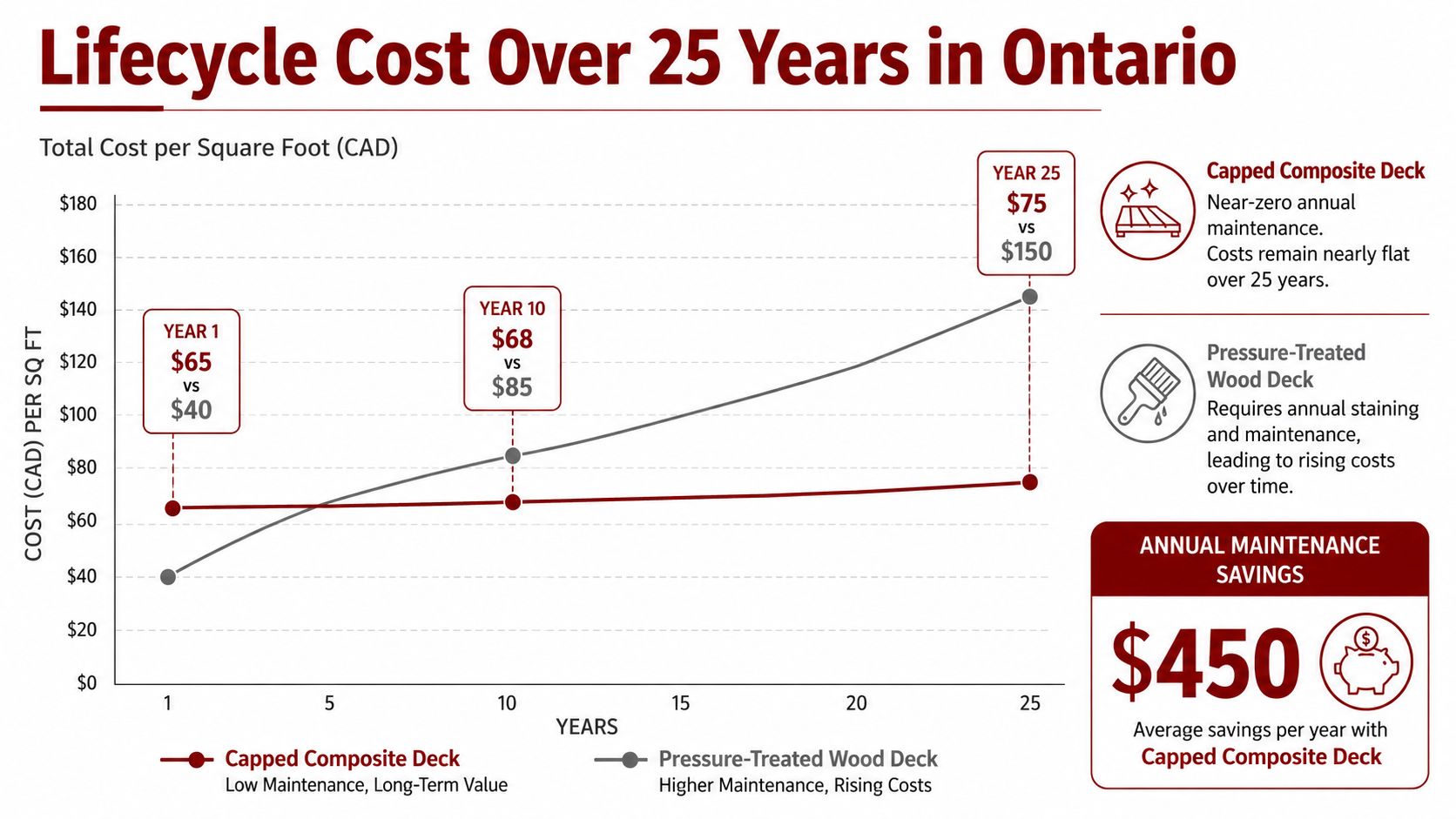
A deck is not a one-time purchase. It has a front-end price, then a long tail of upkeep that keeps showing up in different forms. Canadian cost-comparison guidance says composite typically costs 2–3 times more upfront than wood but can save about CAD $4,000–$6,000 in maintenance over 20 years (Canadian Wood Preservation Association PDF).
What that looks like in real life
Take a 300 square foot Guelph deck. If you choose a capped composite at CAD $65 per square foot installed, the starting number is easy to understand. If you choose pressure-treated wood at a lower upfront price, you still have sealing, staining, and board replacement to pay for over time, and those bills do not wait politely.
The Ontario comparison in the data says composite can end up about CAD $1,700 cheaper than pressure-treated wood over 20 years once upkeep is included. That is the part homeowners usually miss because they focus on the first invoice and ignore what happens after the deck sees a few Ontario winters. The cheap-looking deck in spring can turn into the deck that keeps taking time and money by year ten.
That is why I tell clients to judge a deck by installed cost per usable year. If a deck stays attractive, safe, and low-effort for longer, it delivers more value than a board that costs less on day one but demands constant attention. Homeowners already understand this with other outdoor projects, the same logic shows up in home maintenance costs for Peoria homeowners, where the first price rarely matches the ownership cost.
Here is the video I would point a homeowner to when they want to see the lifecycle trade-off in plain terms.
Performance in a Guelph Freeze-Thaw Climate
Guelph decks fail in a few predictable ways. A board that looks fine in a showroom can get slick when it stays wet, feel too hot on a sunny afternoon, or start looking tired after repeated freeze-thaw cycles. The best value deck in this climate is the one that handles those conditions without turning into a maintenance project.
Wet grip comes first
Comparative technical data show wet slip resistance ranging from 0.31 COF for some mineral composite boards to 0.75 COF for PVC lines, with 0.5 COF or higher treated as slip-resistant in wet conditions (technical comparison). On a family deck, that is the number that matters first. Wet grip separates a deck that feels steady underfoot from one that makes you slow down every time the boards are damp.
Heat impact is often underestimated
The same technical comparison shows surface temperatures can vary a lot in sun. Traditional dark WPC boards can run 155°F–165°F, while cooler premium lines sit lower in the 125°F–135°F and 115°F–125°F ranges on a 90°F day. That matters on south-facing decks in Guelph, especially when kids are barefoot or adults want to use the space in the afternoon. A deck that burns your feet gets used less, and that reduces the value you get from it.
Freeze-thaw is the quiet killer
Moisture cycling is what Ontario does best. It rarely destroys a deck all at once, it wears on the surface, the fasteners, and the finish until the whole structure looks older than it should. Capped boards with better surface protection usually hold up better than the cheapest options, even when the sticker price is higher.
If your deck stays shaded, holds moisture, or gets heavy use from kids and older adults, buy for traction and comfort first. If it faces strong sun, skip the darkest boards unless you are comfortable with extra heat underfoot. If the site stays damp, low upfront cost is not a bargain. It just shifts the pain to later.
Practical rule: For Guelph, the best value board is the one that stays grippy when wet and tolerable in summer sun, not the one with the lowest quote.
Matching the Right Board to Your Household
A good deck choice starts with how you'll use it, not with the brochure photo. A family with toddlers and wet shoes needs a different surface than a retiree who wants zero staining chores, and both of them need a different answer than the homeowner planning to list the house in a few years.
For families with kids
Choose a mid-tier capped composite with stronger wet traction and a solid feel underfoot. That gives you the practical balance I'd want on stairs, landings, and the main walking path. You're paying for safety, easy cleanup, and a surface that doesn't ask for much attention after a muddy weekend.
For retirees who want low upkeep
Go higher on the product ladder and look at a premium PVC-capped line if the budget allows it. That's the board category I'd recommend when a homeowner wants to stop thinking about staining, sealing, and annual touch-ups altogether. The value isn't luxury for luxury's sake, it's convenience and long-term ease.
For budget-focused sellers
Pick a mid-priced capped composite and keep the design clean. Don't overspend on exotic lines or premium options that won't return their cost before you move. A straightforward capped board gives you curb appeal, low maintenance, and a better resale story without overcapitalising the project.
One local option homeowners may compare during the quote stage is Guelph Deck Builders, which offers composite material guidance and full deck construction service in the area. That matters because the right board still needs the right install.
Practical rule: Match the board to the person who'll live with it, not the salesperson who's trying to clear inventory.
Warranty, Permits, and Installation Pitfalls
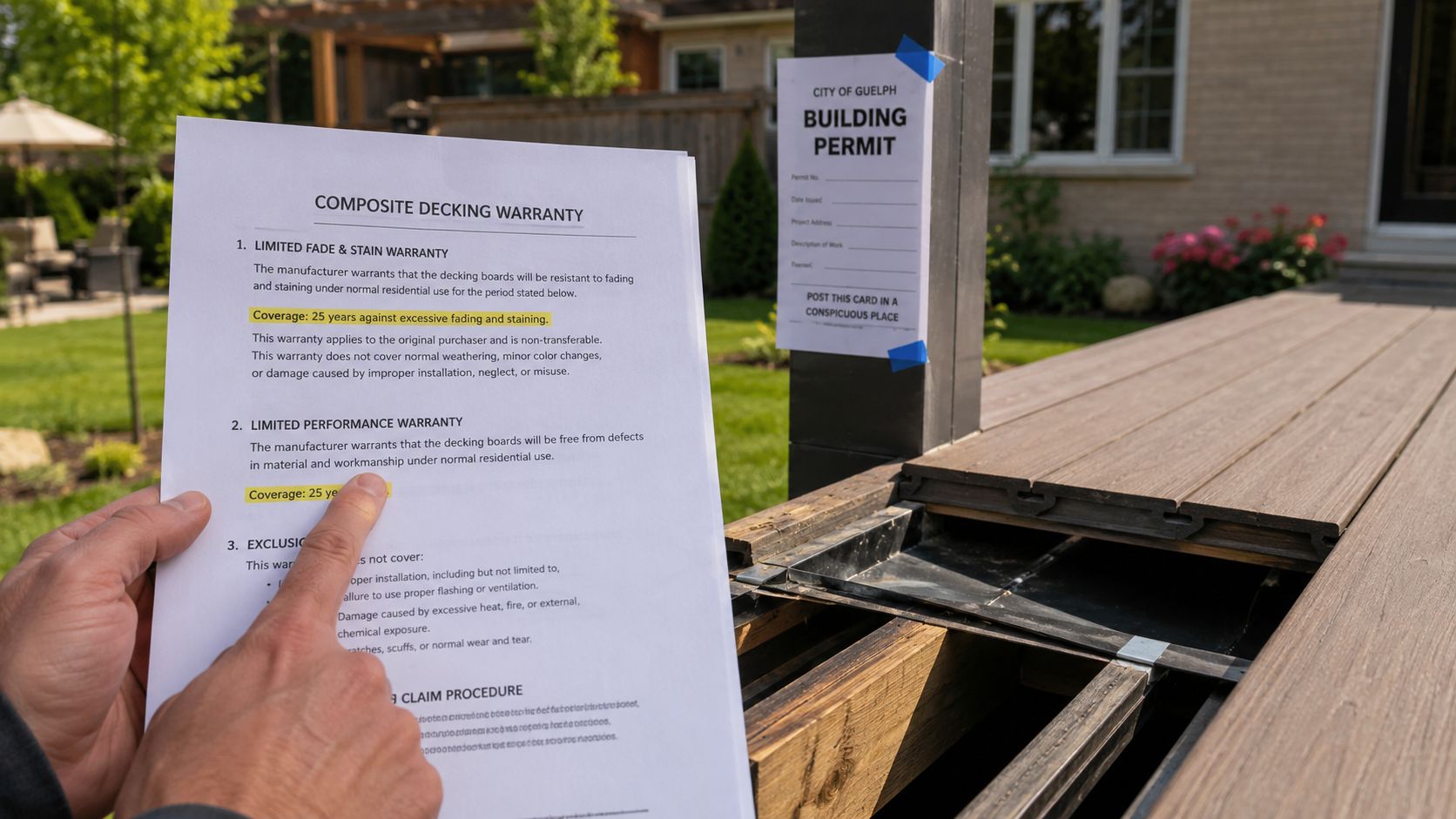
Warranty language only matters if the deck is installed the way the manufacturer expects. Fade coverage, stain coverage, and structural coverage are the clauses homeowners should read first, because those are the ones that affect how the deck looks and lasts in real use. If a contractor ignores the fastening system, joist spacing, or edge details, the warranty can become meaningless in a hurry.
Permit rules matter too. In California, contractors performing a deck addition or replacement attached to a dwelling generally need a building permit, and the fee can be $360 under the state home-improvement permit rule in some cases (Consumer Reports summary of permit guidance). The jurisdiction is different from Ontario, but the lesson is the same, structural deck work isn't a casual DIY decision.
For a Guelph homeowner, the right paperwork and drawings reduce headaches before anyone drives a screw. A local permit-ready process is part of the job, and the municipal rules should be handled before the framing starts. If you want a deeper municipal lens, https://www.guelphdecks.ca/post/deck-building-codes-ontario is the kind of reference worth checking before you sign.
Questions worth asking before you hire
Fastening system: Ask which hidden clips, screws, or plugs will be used, and where you'll see them.
Joist spacing: Ask whether the chosen board requires specific spacing for stairs, borders, or picture framing.
Ledger detailing: Ask how they handle snow load, water management, and flashing at the house connection.
Warranty handling: Ask who keeps the product labels, invoices, and photos if a claim is needed.
Install responsibility: Ask whether the contractor is insured and who is responsible for the permit process.
The board matters, but the install decides whether the board earns its keep.
The Best Value Pick for Guelph in 2026
The best value choice for most Guelph homeowners is mid-priced capped composite installed by a local insured contractor. That's the sweet spot where upfront cost, maintenance burden, and real-world performance line up without paying premium PVC money for benefits many backyards don't need. If you're keeping the deck for 15 years or longer, this is the category that usually gives the strongest return.
I'd narrow it even further. Choose an established capped composite line, not the cheapest uncapped board on the quote sheet, and not the priciest PVC unless your site is especially hot, wet, or high-traffic. Consumer-level pricing often cites composite material costs of about $4–$12 per sq. ft. in the U.S., but that excludes framing, fasteners, trim, permits, and labour, which is why the Guelph decision has to be made on installed value, not board-only pricing (pricing guidance).
That's the whole game. Best composite decking material for the money means the deck that looks good, stays safe, resists Ontario weather, and doesn't turn into an upkeep tax. For most homes here, capped composite does that better than wood, and it does it at a lower lifecycle cost than chasing the cheapest quote.
If you want a deck plan built around Guelph's climate, code requirements, and the installed cost of composite, talk to Guelph Deck Builders. They handle consultation, permit-ready drawings, and installation, so you can compare materials with a contractor who knows what holds up here.
Comments